
The end of school and start of summer means excitement … right??
If what you feel is the opposite of excitement, you’re not alone. The sudden disappearance of the school routine can be anxiety-provoking for parents and children, particularly children with neurodivergence. If you notice feelings of dread (or troublesome behaviors in your child), it’s a great prompt to think through what’s going on — and what could help.
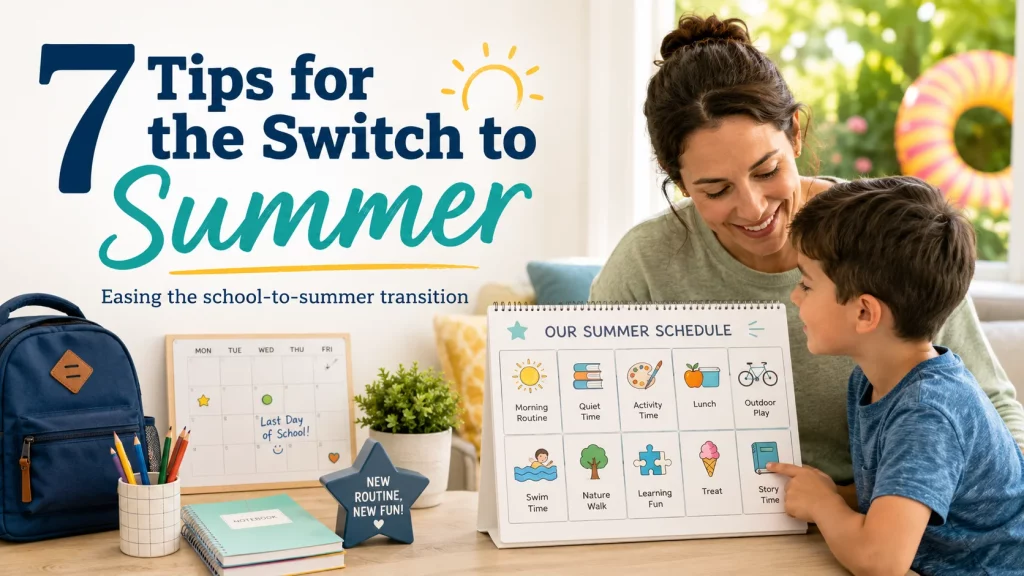
A practical place to start
The suggestions below can help you formulate a strategy for your family. Choose those that seem most realistic in your context. The root goal: A practical routine that eases children’s anxiety and demands fewer decisions on the part of the parent.
- Gradually decompress: Don’t immediately release the entire school schedule; taper down. For example, keep the morning wake time the same for the first two weeks, or reduce structured activities gradually rather than all at once. Think of it as slowly turning down the volume rather than cutting off the audio completely.
- Use the “Anchor Activity” strategy: Anchor your summer days around general activities that stay consistent regardless of other changes — same time, same place, same sequence. Consider keeping a couple of school-time rituals going (such as recess or reading). For example, eat breakfast, read a book or draw (reading or art), do a physical activity (recess), or eat lunch. Summer doesn’t need a full schedule — just a few reliable anchors.
- Make a visual schedule: Display pictures to depict those anchor activities. Some families like using Velcro so children can move activity images from a “to-do” column into a “done” column.
- Offer transition alerts: Warn a child of an upcoming change in activity with a set amount of time (5 minutes, 2 minutes, etc.). This allows a child to prepare for change in a consistent way.
- Communicate with the “First, Then” strategy: This keeps a child oriented toward what’s coming without open-ended unpredictability. It also helps outline boundaries for a “treat” to avoid constant asking or uncertainty. For example, first quiet reading, then pool time; or first lunch, then tablet time.
- Identify your child’s “Sensory Diet” needs: School provides movement breaks, structured sitting, outdoor recess, social interactions and more that make up your child’s “sensory diet.” Think through what your child’s school day was providing sensorially and consciously rebuild those inputs at home. (i.e. Even 10 minutes of jumping, heavy work, or outdoor play at consistent times can offer significant regulation.)
- Monitor your own stress level: The end of the school year, as assessment results and grades roll in, often brings comparison anxiety for parents, on top of the mental burden of impending summer responsibilities and schedules. Find a trusted person with whom you can talk through these concerns. Also, try reframing your idea of progress/growth for your child and celebrating wins in whatever form they take (for example, your child learning to ask for help).
Yes, summer can spark anxiety, but it also offers tremendous potential. Summer doesn’t have to mean a gap in progress. The best therapy happens inside everyday routines — and summer is full of them.
Pariva Health’s experts equip families to craft everyday routines that work, applying multidisciplinary strategies that help the whole family thrive. Find out more about the special ways in which we empower families of neurodivergent children, offering hope and help, with lots of play and no wait list.